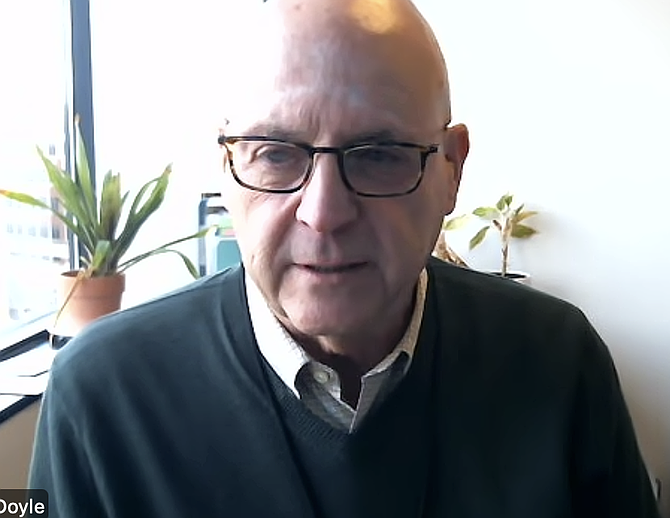
Mike Doyle
Advocates with Northern Virginia Families for Safe Streets say at least 15 pedestrians have been killed in traffic-related crashes and roughly 100 more have been seriously injured in Fairfax County in 2025, underscoring an urgent need for state funding and automated enforcement on the county’s most dangerous corridors.
During a Dec. 30, 2025, interview with The Connection, Mike Doyle, founder and president of Northern Virginia for Safe Streets, emphasized the physics of the crisis, noting that vehicle velocity is the deciding factor between a near miss and a fatality.
“You might survive being hit at 20 mph, but by 40 it’s roughly one in 10 [who survive], and at 50 or 60 it’s essentially over — if you live at all — you’re likely to be permanently, severely injured,” Doyle said. “Speed kills; speed maims.”
Doyle and Phil Abendhower, a volunteer data manager with the group, are calling for increased state funding as newly formed Democratic majorities take control in Richmond. Gov. Abigail Spanberger (D) is set to be inaugurated Jan. 17, three days after the General Assembly session convenes Jan. 14.
A deadly monthlong surge in December which saw five pedestrians killed coincides with efforts by Doyle and Abendhower to support the Speed Safety Camera Expansion Act, HB 2041. Carried by Del. Holly Seibold (D-Fairfax), the legislation seeks to expand Virginia Code Section 46.2-882.1 to authorize localities to place “speed safety cameras” on state-managed high-crash network roads. The bill moves beyond current restrictions that limit cameras to school and work zones, allowing enforcement in “high-risk speed corridors” and high-risk intersection segments with heavy pedestrian activity where speed limits are 45 mph or less. Doyle noted the proposal would specifically target corridors such as Route 29, Route 50, Blake Lane, Columbia Pike, and Duke Street. The bill requires that revenue from fines first cover the camera system's operating costs. "Excess funds" are then directed toward traffic safety. While earlier versions mentioned the Virginia Highway Safety Improvement Program (VHSIP), Seibold also introduced amendments that allow localities to retain these funds in a dedicated local fund for "planning, design, and construction projects for traffic safety, speed management, and bicycle/pedestrian safety."
Seibold introduced the bill in memory of three Fairfax teenagers struck by a student driver going 81 mph in a 35 mph zone in 2022. Two students, 15-year-old Leeyan Hanjia Yan and 14-year-old Ada Gabriela Martinez Nolasco, died from their injuries. The crash occurred on Blake Lane’s sidewalk when they were walking home from Oakton High School.
“Most pedestrian fatalities occur outside school zones. Speed safety cameras, as outlined in HB 2041, save lives by reducing speeding on high-crash corridors with persistent safety risks,” said Seibold in a Jan. 5 email to The Connection.
Seibold’s move follows the Gov. Glenn Youngkin’s 2025 veto of similar legislation. Doyle calls the new proposal the “single most important, high-impact” safety bill of the year. He also supports a separate stop-sign camera bill to collect data on “close calls” involving pedestrians and cyclists.
“On the one hand, there is progress … but we’re far from being satisfied,” Doyle said. “Part of the solution is to apply, on an equitable basis, the technology that exists today to encourage drivers to slow down and stop, because that will save lives.”
The Human Cost
Five deaths in 22 days mark a deadly year-end surge.
The 2025 fatal pedestrian count began with Erica Tibbs, 33, who was struck by a vehicle Jan. 29, 2025 at Richmond Highway and Buckman Road.
dFollowing a summer and autumn of scattered incidents, the toll surged in the final weeks of 2025, claiming five lives in just 22 days. This deadly streak began when Roger Brown, 67, was killed Dec. 7 at Richmond Highway and Backlick Road.
On Dec. 23, 50-year-old Jimmy Patterson was found in a low point of the Fairfax County Parkway median, where he had been invisible to traffic for hours. On Christmas Day, a 75-year-old and a 15-year-old were killed in an Interstate 495 crash investigated by Virginia State Police. The year’s latest tragedy occurred Dec. 29, when a 53-year-old woman of no fixed address was struck twice at Route 29 and Hideaway Road; the second vehicle fled the scene.
“In a perfect world, I would love to see no fatalities at all, and automobiles have come a long way, but you still have these huge vehicles and you have small people,” said Phil Abendhower, a data volunteer for Northern Virginia Families for Safe Streets (NoVA FSS), during a Dec. 30 interview with The Connection.
While fatalities dropped from 20 last year to approximately 15 this year, NoVA FSS founder Mike Doyle cautioned that serious injuries, the life-altering crashes that often go unhighlighted, remain flat at about 100 per year.
Beyond Behavior
Why road design dictates pedestrian fatality rates.
“Safety is a design problem, not a behavioral one,” said Mike Doyle, founder of Northern Virginia Families for Safe Streets (NoVA FSS), during a Dec. 30 interview with The Connection.
He noted that corridors such as Route 29 and the Fairfax County Parkway feature 12-foot lanes that subconsciously encourage highway speeds. Furthermore, a significant “visibility gap” exists: four out of five fatal pedestrian crashes in the county occur after dark, often in areas where streetlights are spaced for vehicles.
Doyle added that pedestrian collisions represent a “systemic failure” of road design rather than individual behavioral errors. While programs like the FCPD’s “Road Shark” provided high-visibility enforcement in 2025, yielding nearly 50,000 citations, a 43% increase from the previous year, advocates like Doyle argue that police presence alone cannot be everywhere 24/7.
The 2026 legislative push is bolstered by other members of the Northern Virginia delegation moving toward engineering mandates. Sen. Danica Roem (D-Manassas), is proposing funding for lighting and pedestrian bridges on Route 28.
“My Route 28 STARS project for Manassas Park and Yorkshire includes innovative intersection designs, a raised median and 1.75 miles of contiguous sidewalk — including pedestrian refuges to make road crossings safer,” said Roem in an email on Jan. 3.
At the same time, Del. Kathy Tran (D-Fairfax), is working to establish stricter engineering standards for the Springfield-Merrifield corridor through House Bill 42, often referred to in legislative previews as the “Safer Roads for Springfield-Merrifield Act.” According to legislative filings for the 2026 session, Tran is seeking to mandate that the Virginia Department of Transportation (VDOT) prioritize safety-first design on high-traffic state roads. Her proposal includes lane narrowing (moving away from 12-foot highway-style lanes), reduced crossing distances through pedestrian refuge islands on stretches such as Old Keene Mill Road (Route 644) and Route 50, and the requirement of “Leading Pedestrian Intervals” (LPIs) to provide pedestrians with a three- to seven-second head start at intersections.
Doyle argues that until these systemic design flaws are addressed, the fatalities will continue regardless of police presence. Phil Abendhower, a NoVA FSS data volunteer, noted that the group uses community data to identify dangerous intersections before a fatality occurs. Residents can record a close call on the NoVA FSS Near Miss Dashboard at novasafestreets.org/report-a-safety-issue.
Community Action and Police Information
Detectives from the FCPD Crash Reconstruction Unit are searching for the driver of the second unidentified vehicle involved in the Dec. 29 fatality at Route 29 and Hideaway Road.
* Call the Tip Line: 703-280-0543.
* Call Fairfax County Crime Solvers Anonymously: at 1-866-411-TIPS (8477).