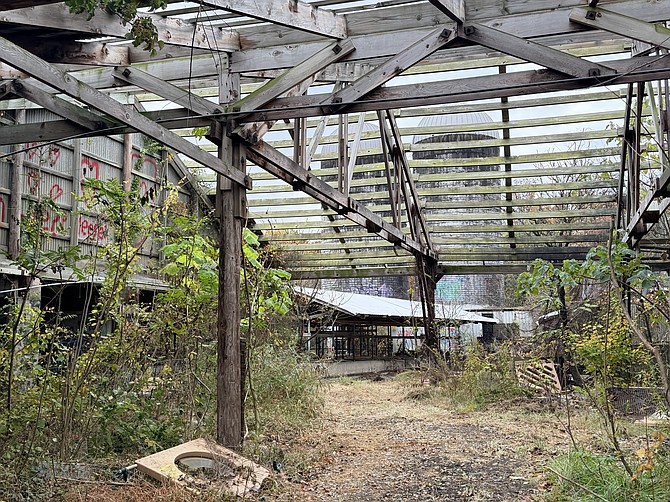
Seen immediately before demolition began, roof sections are missing, graffiti marks the surfaces, and invasive plants have a pervasive hold
The south county is losing a bit of its history. The old dairy and feed barns on the grounds of present day Laurel Hill Park near the Laurel Hill Equestrian Center, formerly part of the Occoquan Prison complex, are undergoing demolition. The barns’ demise follows that of another prison era barn, taken down about 10 years ago after its near collapse. That cleared space made room for the current equestrian ring, established on the site in 2014. This latest building tear-downs will not support any current plans for new park features. According to Park Authority spokesmen, the removal is solely for safety reasons. Demolition work will be completed by about the end of the year. Laurel Hill Park and trails will remain open as work progresses.
The Farm Years
One of the last private owners of the property where the dairy barn sat was Elizabeth Violette. She as a widow who purchased this additional farmland in 1846 to combine with the land she had inherited from her husband, Thompson Violette; as well as land she acquired when widowed in her first marriage.
Tax records in 1861 recorded her property as “three slaves, two horses, ten cattle, and five hogs.” According to records in the Fairfax County archives, during the Civil War, her large house was used as a landmark, as well as a campsite by the 2nd Pennsylvania Cavalry. Although there were no large battles there, it was the site of a skirmish in 1863, when the 4th Virginia Cavalry surprised the Union soldiers encamped there. The skirmish left three Union soldiers wounded or dead, 20 captured, and two Confederate soldiers wounded.
Violette’s 167-acre property likely suffered from the same lack of productivity as her neighbors’ farms at the time. Violette died in debt around 1873. Her property was split into four tracts bequeathed to her four children. In satisfaction of her debts, the county commissioner’s office later ordered the sale of 84 acres, which was described as “of good quality and well located.” The purchaser, Luther Denty, owned the parcel just a few years until it was seized by the government in 1910 to establish the workhouse. He had paid $3,349 for a total 212 acres, or approximately $16 per acre, including the 84 acre plot that had belonged to the Violette family.
The Workhouse and Reformatory Years
During the period the D.C. workhouse and reformatory were open, beginning about 1910 to 1912, the workhouse prisoners operated a large farm with several agriculture ventures on the grounds. DC archives indicate that the land was prepared for crops, and fertilized using horse manure collected on the streets of Washington and barged down the Potomac River to a newly built Occoquan River landing. The farming soils in the area had been worked to near depletion by overproduction of tobacco prior to the Civil War. Once exhausted, much of the land had been left fallow and uncultivated, beginning in the 1840s, until after the war.
During the workhouse years, inmate workers established a tree orchard; beef and hog ranches; poultry farm with chickens and geese; crop areas growing corn, wheat and hay to feed the animals; the dairy operation; and vegetable gardens. The farm production fed the prison population, providing for their immediate needs, with some preserved for the winters.
The facility closed as a workhouse and reformatory in 1968, and instead focused on penitentiary use; first as a minimum security prison, then as a maximum security facility. It began to house career criminals and those thought to be dangerous, serving long-term sentences without parole consideration. They had little incentive to work in prison operations, as accounted in the pictorial history, Images of America, Lorton Prisons by Alice Reagan and Kenena Hansen Spalding. The prison closed in 2001.
The diary continued operation after the workhouse ceased other operations. It moved to the Furnace Road location with the building of the new dairy and feed barns about 1962. The update included automated milking machines, which allowed the milk to be packaged and distributed to DC schools and hospitals. Decades later, the prison closed completely as Congress passed the Lorton Technical Corrections Act in October 1998. The Act transferred the prison property to the General Services Administration, in advance of purchase by Fairfax County, which was required to submit an acceptable reuse plan before acquisition. The dairy operation was the last of the prison operations to close. Leading up to the closure, some current local residents driving on Hooes Road remember seeing the cows grazing in pasture on land that is now the site of Laurel Hill Golf Club. The cows were sold at auction in 1998, after producing over 1,600 gallons of milk in that last year. The closure and livestock sale also marked the end of commercial dairy production in Fairfax County.
The Demolition
In recent years, despite chainlink fencing, the barn complex experienced trespass, vandalism, extensive graffiti on most surfaces; and was even the site of a suicide. The tin roof had been in disrepair, with sections missing. The presence of asbestos was suspected in the milking barn area. Overall, the barn was not judged to be salvageable. The county is paying
a contractor about $238,600 for demolition of the complex, which includes nine structures and three feeders.
The full Lorton complex is listed on the National Register of Historic Places. The dairy operation buildings are considered “non-contributing” to the historic value. Only the two concrete silos, and a third silo farther from the current barn site, will mark the space the dairy cows once occupied. The silos are tall and cylindrically shaped, typical of the buildings used in the later part of the 1900s when silos were a common feature of dairy barns; used for fermenting and storing corn and other crops fed to the cows. About 35 feet in diameter, they are built with masonry material, with exterior steel reinforcing rings at three foot intervals, as described in National Register documents. The complex’s concrete floors also will remain, according to the county, as not to impact any potential archeological features lying beneath. The Park Authority indicates the iconic silo structures will continue to be preserved.
Other workhouse and prison era buildings dot the landscape, mostly hidden by overgrowth. The cows’ pasture lands are still, for the most part, open meadows, scattered with some invasive non-native trees. Sections of barbed-wire fencing and a few metal cattle gates are still visible. The tall silos stand, an iconic marking of Fairfax County’s past, more than a century ago, as a farming community.