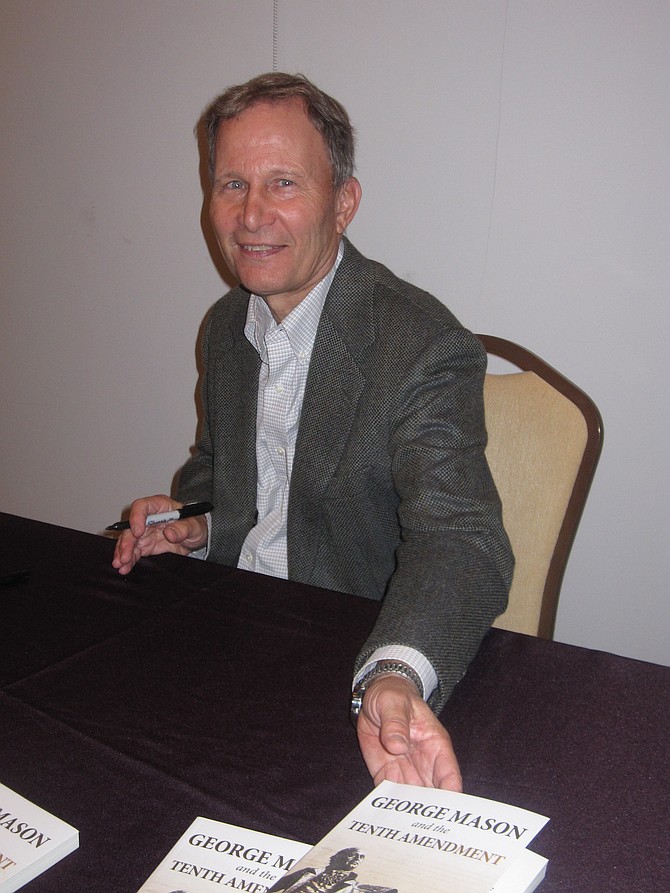
On Oct. 7, the 228th anniversary of George Mason IV’s death, Mason Neck resident Dr. John C. Rand told a gathering that Mason was “the most significant man in America at certain critical times.” He argued that Mason’s ideas and writings greatly influenced the North American colonies’ Declaration of Independence, the U.S. Constitution and constitutions of other countries.
Rand’s new book, “George Mason and the Tenth Amendment,” was on sale for the first time at the Oct. 7 event at Gunston Hall, hot off the George Mason University Press.
Mason (1725–1792), who owned the Gunston Hall plantation in southeastern Fairfax County, was the chief author of the U.S. Constitution’s Tenth Amendment. He also was the primary author of the 1776 Virginia Declaration of Rights, a founding document that historians say was the first to support individual liberties such as freedom of religion and the press.
Mason helped write the Fairfax Resolves, “one of the first documents to question British authority over the colonies,” urging a boycott of British goods, Rand said. Mason was the principal author of the Virginia Constitution, a document that inspired Thomas Jefferson in writing the Declaration of Independence.
The 1787 Constitutional Convention in Philadelphia was a “rancorous convention,” Rand noted. Mason advocated for provisions guaranteeing individual rights and refused to sign the Constitution because it lacked protections for individual liberties like freedom of speech and assembly.
Once the Constitution was proposed to the states for ratification, “Mason was the face of opposition to the new Constitution,” said Rand, because a bill of rights was not included. Mason was “pilloried in the press,” Rand told the attendees. The Bill of Rights was added and ratified in 1791.
The Tenth Amendment
Having revolted against the British monarchy, the convention delegates had heated debates about the powers of the new federal government versus the states’ powers. James Madison and Alexander Hamilton “wanted a strong national government.” Mason “was a localist. The division of authority was important to George Mason,” said Rand.
The Tenth Amendment to the Constitution reads: "The powers not delegated to the United States by the Constitution, nor prohibited by it to the States, are reserved to the States respectively, or to the people."
“It is one of the most critical Constitutional clauses of the Constitution,” Rand opined.
The Tenth Amendment has been used in numerous cases over the years, for example, to support slavery before the Civil War and discrimination against African Americans after the Civil War. “The legal rationale was the same after as well as before the Civil War; the Constitution through the Tenth Amendment had guaranteed states the right to manage their internal affairs,” Rand wrote in his book.
Dobbs v. Jackson Women’s Health Organization, was a 2022, abortion case that overturned Roe v. Wade. In Roe v. Wade, the 1973 landmark, U.S. Supreme Court decision ruled that unduly restrictive state regulation of abortion is unconstitutional. Mississippi argued that the state had the power under the Tenth Amendment to choose to restrict abortions. (The Supreme Court decided the case under another amendment, the Fourteenth.)
On how much power to give the states, Rand said, “We have George Mason to thank for what we have today.”
Pohick Episcopal Church’s Rev. Daniel Cenci commented that Mason was on the church’s vestry for 36 years. Cenci offered a benediction thanking God for “a nation founded on the basis of freedom, liberty and justice” and urged that all “strive for equality.”
John Rand, an attorney, received a PhD in American history from George Mason University in 2024.
Verbatim:
"Is there anything in this constitution which secures to the states the powers which are said to be retained? Will powers remain to the states which are not expressly guarded and reserved?
"I wish a clause in the constitution with respect to all powers which are not granted, that they are retained by the states. Otherwise the power of providing for the general welfare may be perverted to its destruction."
-- George Mason, 1788